No experience, no gear, no idea where to start. Here is the real path from asking the question to riding the engine, and what the department covers along the way.
To become a volunteer firefighter in Indiana you need to be eighteen, pass a background check and a physical, and commit to roughly 150 to 240 hours of training before you ride as an interior firefighter. You do not need prior experience, your own gear, or any money up front. The department supplies the equipment and the training. What it asks for is your time.
People ask us about this at the fair, in the grocery store, and in the comments on our videos. The question behind the question is usually the same one: could someone like me actually do this? Here is the honest answer, with the parts most recruiting pitches leave out.
What you need before you start
The entry requirements are less demanding than most people expect:
- Eighteen years of age or older
- A valid driver's license
- A clean background check
- A physical confirming you can do the work safely
- Residence in or near the response district, so you can reach the station in a reasonable time
That is the gate. Everything else is taught.
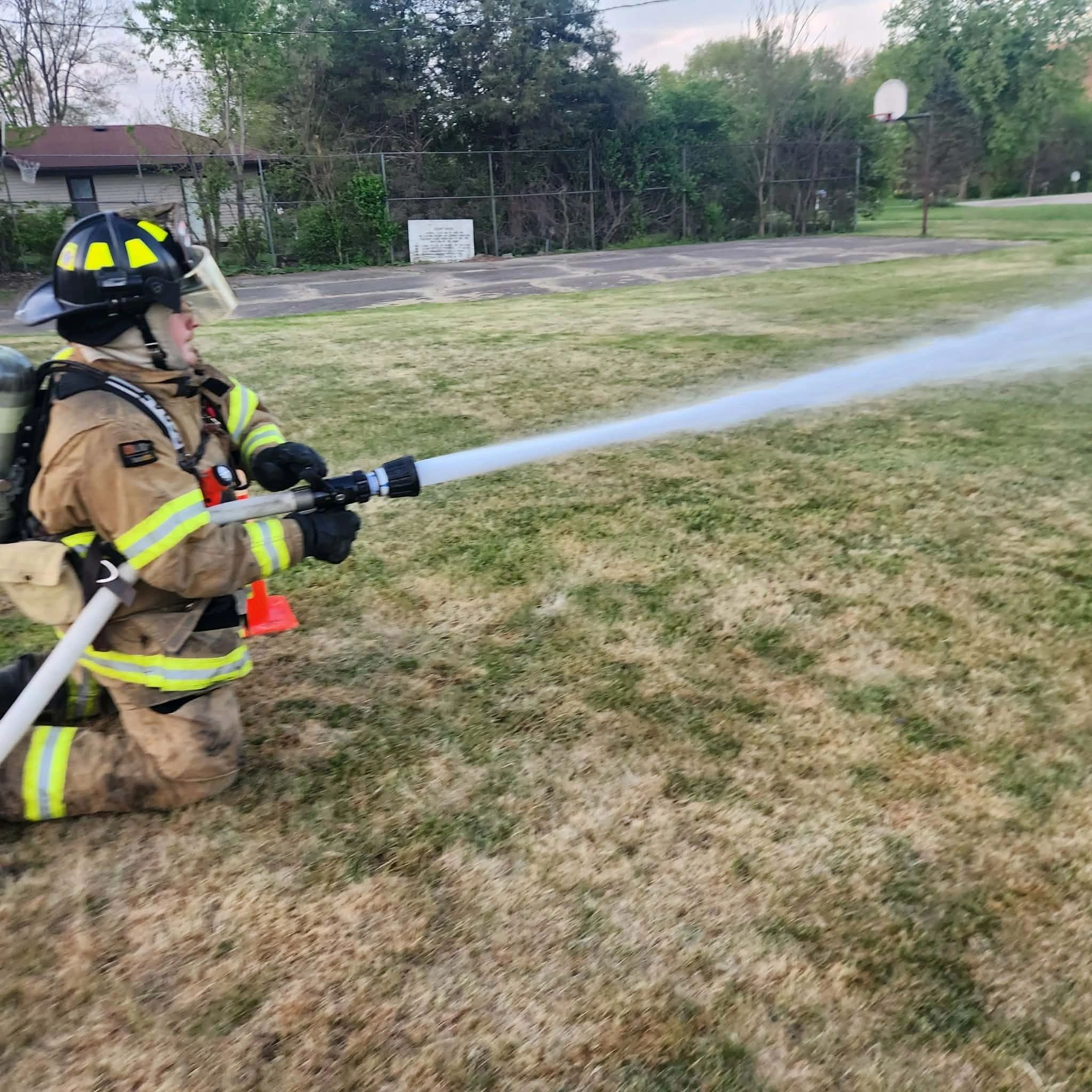
The physical standard is real but it is not a special-forces selection. You need to be able to carry equipment, climb stairs in gear, and work hard for stretches at a time. Turnout gear and an air pack add something in the region of sixty pounds. Plenty of volunteers get into better shape because they joined, not before.
What the training actually looks like
Indiana structures firefighter training around nationally recognized certifications, delivered locally through departments, district training facilities, and the state fire academy system. The usual sequence looks roughly like this:
| Stage | Approximate hours | What you learn |
|---|---|---|
| Mandatory / entry-level | 35–40 | Fire behavior, personal protective equipment, safety, the incident command system |
| Firefighter I | 60–80 | Hose, ladders, ventilation, search and rescue, SCBA under working conditions |
| Firefighter II | 40–60 | Fire attack decisions, vehicle fires, foam, working as part of a crew on a scene |
| Emergency medical | 40–60 | Emergency medical responder or EMT, CPR, AED, patient assessment |
| Hazmat awareness and operations | 16–24 | Recognizing hazardous materials and acting safely at that level |
Add the department's own ongoing monthly training and you are looking at six months to a year before you are fully interior qualified, depending on how classes fall and how much you can take on at once.
Nobody expects you to do all of it immediately. You will be useful long before you are finished — pulling hose, running a pump, managing water supply, handling traffic, helping on medical calls.
Why so much of it is medical
This surprises people. The National Volunteer Fire Council reports that call volumes nationally have more than tripled over the last forty years, and the growth has come overwhelmingly from emergency medical calls rather than fires.
Abington is no different. On a given month you are far more likely to be responding to a fall, a cardiac event, or a crash on a county road than to a structure fire. The department operates as a non-transport basic life support provider, which means we arrive, stabilize, and work alongside the transporting ambulance service.
If medical work is the part that interests you most, that is a completely legitimate way into the fire service, and it is where the need is greatest.
What it costs you, and what it costs the department
You do not pay tuition and you do not buy gear. The department covers it. That is the part worth understanding, because it is where the fundraising comes in.
A single set of structural turnout gear runs into the thousands of dollars. A self-contained breathing apparatus costs several thousand more, and the cylinders and the cascade system that fills them need testing and maintenance. Certification courses cost money. So does the fuel to get a truck to a training ground.
Abington has leaned on grants and on neighbors to close that gap — a Whitewater Valley REMC grant of more than $10,000 went into training, radios, breathing apparatus, repairing the cascade system, and CPR equipment. Reid Health donated two AEDs to replace outdated units. Those are real examples of community money turning directly into capability.
When you see us selling coloring book sponsorships or running a store, that is what it funds. Not decoration. Certification hours and air.
What the first year feels like
Awkward, then suddenly not. You spend the first weeks learning where everything lives on the truck and feeling like you are in the way. Then one night something clicks and you realize you reached for the right tool without thinking about it.
The pager going off during dinner stops being an interruption and becomes a thing your household understands. You will miss calls. Everyone does. Coverage is a team property, not an individual one.
And you will learn things that follow you home. How to stop bleeding. How to run CPR properly. How to stay calm and make decisions in the first sixty seconds of something bad. Those do not expire when you take the pager off.
If interior firefighting is not for you
Say so, and come anyway. Departments run on more than people who go through the door. There is pump operation, water supply, traffic and scene safety, air management, equipment maintenance, administration, grant writing, fundraising, social media, and the auxiliary. Abington runs fifteen active firefighters covering a twenty-one-square-mile township. Every hour somebody else absorbs is an hour a firefighter gets back.
If any of this sounds like something you want to ask more about, start with the volunteer page or call the station at (765) 855-3950. The conversation costs you nothing, and we would rather answer ten questions now than have you talk yourself out of it from the outside.
Common questions
Do I need experience to become a volunteer firefighter?
No. Most volunteers arrive with none. Departments are built to train people from zero, and the first months are deliberately structured around learning the equipment, the radio, and the basics before you are asked to do anything difficult.
How many hours of training does a volunteer firefighter need in Indiana?
Roughly 150 to 240 hours to reach interior firefighter status, depending on which certifications you pursue and how your department sequences them. That is typically spread over six to twelve months of evening and weekend sessions.
Does it cost money to become a volunteer firefighter?
The department provides turnout gear, breathing apparatus, and training. What it costs you is time. That is precisely why fundraising matters: every set of gear and every certification course a department pays for is money it has to raise first.
Can I volunteer if I have a full-time job?
Yes, and most volunteers do. Departments build the roster around the reality that people work. You are not expected to make every call. Coverage comes from a group of people each giving the hours they genuinely have.
What is the minimum age to be a volunteer firefighter in Indiana?
Eighteen for full firefighter duties. Some departments run junior or explorer programs for younger people interested in the fire service, which cover training and station work without interior fire attack.
Sources
- National Volunteer Fire Council. Volunteer Fire Service Fact Sheet
- Abington Township Volunteer Fire Department. Department history
Supporting the department
The gear and certifications the department hands a new volunteer were paid for before they walked in. This is how that gets paid for.
- The department store. We have stood up a store so the community can back the department directly. Every purchase helps pay for training hours, replacement gear, and the fire education we bring into Abington Township homes and classrooms.
- The community coloring book. A 40-page safety and coloring book built for Abington families, with local scenes, a twelve-month family safety calendar, and fire safety pages children actually use. Sponsorships and the Firefighter’s Hat Fund put the proceeds straight into training and community fire education.
- Our channels. Watch the crew at work on YouTube and follow day-to-day department news on Facebook.
- The Station News. Our free monthly newsletter — calls, training, events, and what the department needs — delivered once a month. Sign up on the newsletter page and you will not miss anything that happens in the township.
Frequently asked questions
Do I need experience to become a volunteer firefighter?
No. Most volunteers arrive with none. Departments are built to train people from zero, and the first months are deliberately structured around learning the equipment, the radio, and the basics before you are asked to do anything difficult.
How many hours of training does a volunteer firefighter need in Indiana?
Roughly 150 to 240 hours to reach interior firefighter status, depending on which certifications you pursue and how your department sequences them. That is typically spread over six to twelve months of evening and weekend sessions.
Does it cost money to become a volunteer firefighter?
The department provides turnout gear, breathing apparatus, and training. What it costs you is time. That is precisely why fundraising matters: every set of gear and every certification course a department pays for is money it has to raise first.
Can I volunteer if I have a full-time job?
Yes, and most volunteers do. Departments build the roster around the reality that people work. You are not expected to make every call. Coverage comes from a group of people each giving the hours they genuinely have.
What is the minimum age to be a volunteer firefighter in Indiana?
Eighteen for full firefighter duties. Some departments run junior or explorer programs for younger people interested in the fire service, which cover training and station work without interior fire attack.