Twelve months of drills, from hose evolutions in the spring to ice rescue awareness in January. A look at how an Abington crew stays ready for calls it hopes never come.
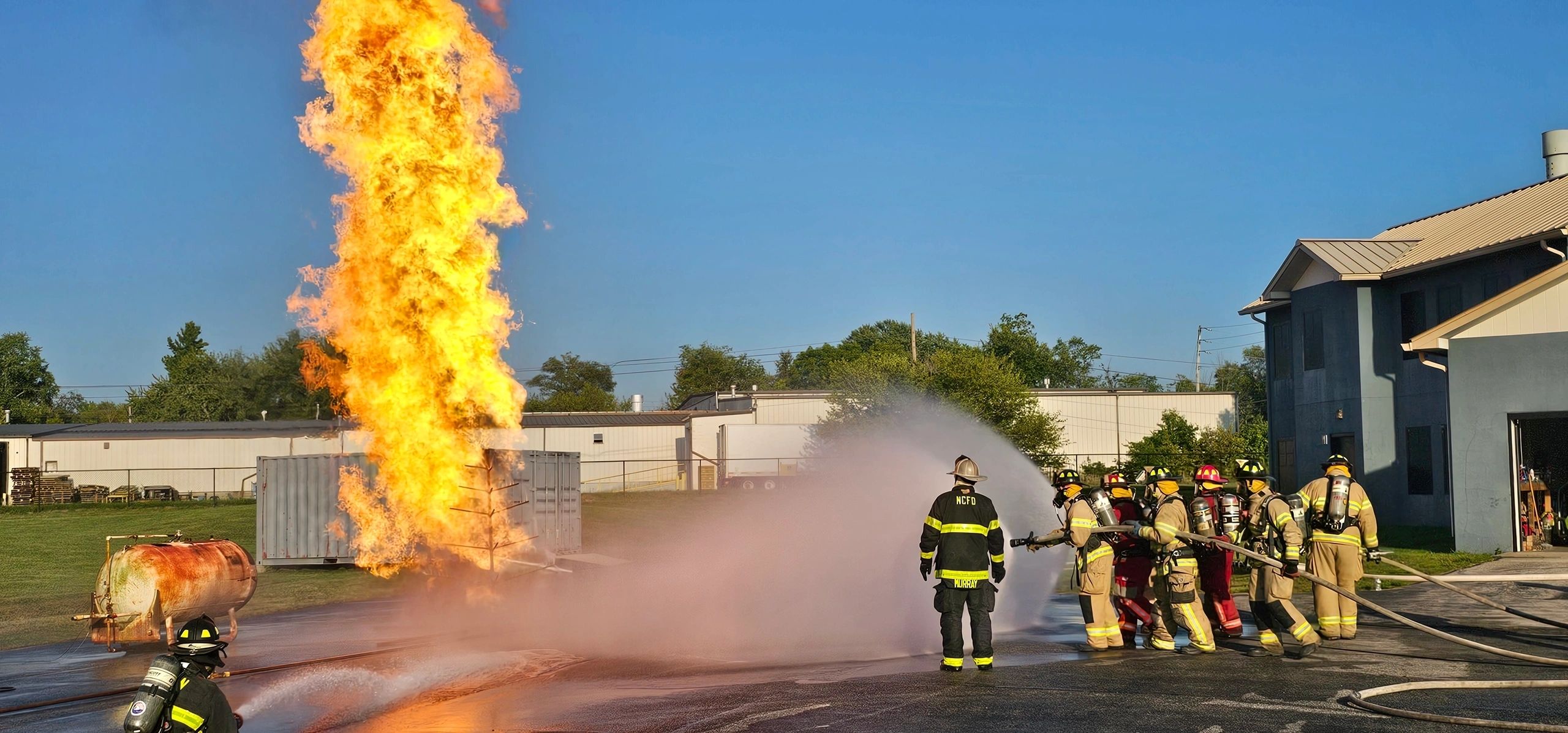
A volunteer fire department trains all year, on a rotating schedule, whether or not anyone new has joined. Most hold formal drills at least monthly plus regular equipment checks, cycling through hose work, ladders, breathing apparatus, search, extrication, water supply, and medical skills so that every member touches every core skill within the year.
People sometimes assume firefighters train when something changes — a new truck, a new recruit, a new rule. The opposite is true. The schedule exists precisely because nothing changed. Skills decay quietly, and the only way to find out whether yours have is to use them before the night you need them.
Here is roughly what a year looks like in a department like ours.
The things we drill every single month
Three things never leave the schedule, because they are the three that fail first under stress:
- Hose deployment. Pulling a line off the truck, advancing it, getting water, and moving with it. It looks simple from the road. It is awkward, heavy work in a dark hallway with a charged line that wants to catch on every corner.
- SCBA. Donning the breathing apparatus quickly and correctly, managing your air, knowing the sound of your low-air alarm and what it means about how much time you have left.
- Patient assessment. Because it is the skill we use most.
There is nothing glamorous about any of it. That is rather the point. The impressive-looking training is not usually the training that saves someone.
Spring: water, pumps, and the ground
As soon as the weather allows, departments get back outdoors. Pump operations, drafting, and hose testing dominate the spring, along with wildland and grass fire work — Indiana field and ditch fires pick up as things dry out.
For Abington this is also when the water supply drills happen in earnest. Most of our twenty-one square miles has no hydrants, so our water arrives on a truck. The founding department worked with an 800-gallon tanker and a 1,000-gallon Fold-A-Tank, and the principle has not changed even as the equipment has: get water to the scene, dump it into a portable tank, and keep a shuttle moving so the attack line never runs dry.
A tanker shuttle done well is a genuinely satisfying thing to watch. Done badly, the line goes soft at the worst moment. So we practice it.
Summer: ladders, extrication, and heat
Summer brings ladder work, roof operations where safe to practice, and vehicle extrication. Rural roads in Wayne County produce serious crashes, and cutting a car apart around a patient is a skill with a lot of moving parts — stabilization, glass management, choosing where to cut, and doing all of it while somebody else is managing the patient inside.
Donated tools matter here more than people realize. Citizens First Fire Training provided the department with a battery-operated combination tool, and Bomgaars in Richmond donated DEWALT tools to replace battery equipment that had stopped working. On an extrication, the difference between a tool that holds charge and one that does not is measured in minutes of someone's life.
Summer is also when heat becomes its own training subject. Rehab, hydration, and recognizing when a firefighter needs to come out are part of the drill, not an afterthought.
Autumn: live fire and the real thing
Autumn is live burn season, when conditions are cool enough to work safely in gear. Live burn training takes place in a purpose-built burn building or an acquired structure under tight safety rules, with instructors, dedicated safety crews, and a charged backup line.
It is the closest thing to the real event that training can provide: actual heat pressing down, actual smoke taking your visibility, the genuine disorientation of a space you cannot see in. Reading fire behavior from a textbook and reading it through a mask are different skills, and only one of them helps at two in the morning.
Fire Prevention Week lands in October too, which turns part of the month outward — school visits, station tours, and the community fire and CPR program.
Winter: the classroom, the cold, and the gear
Winter pushes training indoors and toward the things that need thinking rather than sweating. Incident command, pre-planning the buildings in the district, mutual aid procedures with neighboring Wayne County departments, hazardous materials refreshers, and the certification coursework members are working through.
Cold brings its own call types: chimney and wood stove fires, carbon monoxide, ice and water awareness, and the simple problem of working a scene when everything freezes, including the hose.
Winter is also when equipment gets serious attention. Air cylinders tested, the cascade system checked, batteries cycled, AEDs verified, radios inventoried. It is unglamorous and it is training in the truest sense: finding the failure on a Tuesday evening in the bay rather than on a Saturday night in somebody's kitchen.
Where simulation is starting to fit
One genuinely new development is the use of simulation for the decision-making half of the job. Departments are experimenting with scenario software and simulation environments — the department is connected to Firebreak Command, a browser-based firefighting simulation — to run size-up, crew assignment, and communication repeatedly without burning fuel or putting anyone in gear.
It is worth being precise about what this does and does not do. It does not replace live fire training, and it is not a certification. What it offers is repetition of judgment: what do you see on arrival, what do you call for, who goes where, and what do you do when the first plan does not work. Those reps are expensive to buy in the real world and cheap to buy in a simulator.
For a volunteer department counting every gallon of fuel and every unpaid hour, that trade is worth exploring.
Why any of this should matter to you
Because the training year is most of what your fire department actually does. The calls are the visible part. The hours in the bay on a Thursday night, in the rain, running the same hose evolution for the fourth time, are the part that determines how the calls go.
Every one of those hours is unpaid. Every certification behind them was paid for by somebody. That is the whole case for supporting a volunteer department, and it is the quietest part of the job.
Common questions
How often do volunteer firefighters train?
Most volunteer departments hold formal training at least monthly, often twice a month, plus equipment checks on a weekly or biweekly cycle. Individual members add certification courses on top of that throughout the year.
What do firefighters practice most often?
The basics: deploying and advancing hose lines, throwing ladders, working on air with SCBA, search patterns, and patient assessment. These are drilled repeatedly because they need to work without conscious thought when conditions are bad.
How do rural fire departments get water without hydrants?
Through tanker shuttles and drafting. Tankers haul water to the scene and dump it into portable tanks, while an engine drafts from a pond, creek, or dry hydrant. Running a shuttle smoothly is a drilled skill in its own right.
What is live burn training?
Controlled fire training in a purpose-built burn building or an acquired structure, under strict safety rules. It lets firefighters experience real heat, smoke, and fire behavior with instructors present and multiple safety crews standing by.
Can simulation really help firefighter training?
It helps with decision-making and crew coordination rather than physical skill. Simulation lets a crew run through size-up, assignments, and communication many times over without fuel, apparatus wear, or risk. It supplements live training; it does not replace it.
Sources
- National Volunteer Fire Council. Volunteer Fire Service Fact Sheet
- Abington Township Volunteer Fire Department. Department history
Supporting the department
Every hour described above is unpaid, and every certification behind it was bought. Here is where that money comes from.
- The department store. We have stood up a store so the community can back the department directly. Every purchase helps pay for training hours, replacement gear, and the fire education we bring into Abington Township homes and classrooms.
- The community coloring book. A 40-page safety and coloring book built for Abington families, with local scenes, a twelve-month family safety calendar, and fire safety pages children actually use. Sponsorships and the Firefighter’s Hat Fund put the proceeds straight into training and community fire education.
- Our channels. Watch the crew at work on YouTube and follow day-to-day department news on Facebook.
- The Station News. Our free monthly newsletter — calls, training, events, and what the department needs — delivered once a month. Sign up on the newsletter page and you will not miss anything that happens in the township.
Frequently asked questions
How often do volunteer firefighters train?
Most volunteer departments hold formal training at least monthly, often twice a month, plus equipment checks on a weekly or biweekly cycle. Individual members add certification courses on top of that throughout the year.
What do firefighters practice most often?
The basics: deploying and advancing hose lines, throwing ladders, working on air with SCBA, search patterns, and patient assessment. These are drilled repeatedly because they need to work without conscious thought when conditions are bad.
How do rural fire departments get water without hydrants?
Through tanker shuttles and drafting. Tankers haul water to the scene and dump it into portable tanks, while an engine drafts from a pond, creek, or dry hydrant. Running a shuttle smoothly is a drilled skill in its own right.
What is live burn training?
Controlled fire training in a purpose-built burn building or an acquired structure, under strict safety rules. It lets firefighters experience real heat, smoke, and fire behavior with instructors present and multiple safety crews standing by.
Can simulation really help firefighter training?
It helps with decision-making and crew coordination rather than physical skill. Simulation lets a crew run through size-up, assignments, and communication many times over without fuel, apparatus wear, or risk. It supplements live training; it does not replace it.